Leave Your Message
Choosing among the 2026 best Rattan Sticks wholesale suppliers requires more than comparing catalog prices. Buyers must examine species, cane maturity, diameter consistency, moisture control, treatment methods, and shipment reliability. A polished bundle can still hide brittle cores, uneven lengths, or excessive surface cracking.
The International Bamboo and Rattan Organisation (INBAR) reports that bamboo and rattan support livelihoods for more than 1.5 billion people worldwide. Its publications also emphasize sustainable harvesting, value-chain improvement, and stronger market access. These priorities matter for wholesalers handling furniture frames, baskets, lampshades, garden structures, and craft materials. The Food and Agriculture Organization’s Global Forest Resources Assessment 2020 records forests covering approximately 4.06 billion hectares, but forest availability does not guarantee responsible rattan supply. Origin and traceability still need checking.
Dr. C. Renuka, a widely cited Indian rattan researcher, has stressed that “rattan management must combine conservation with productive use.” That principle should guide supplier evaluation in 2026. The quotation is useful, but it is not a substitute for documentation. Ask for harvest-region details, treatment records, moisture specifications, packing photographs, and independent quality checks.
Real buying decisions are rarely perfect. A low quote may reflect efficient processing, or simply weaker grading. A premium supplier may offer better consistency, but not always better service. This guide compares leading wholesale options through practical evidence, including product quality, responsible sourcing, customization, minimum order quantities, and export experience. Small details matter. A split cane can damage an entire finished product.
What Are Rattan Sticks and How Are They Used?
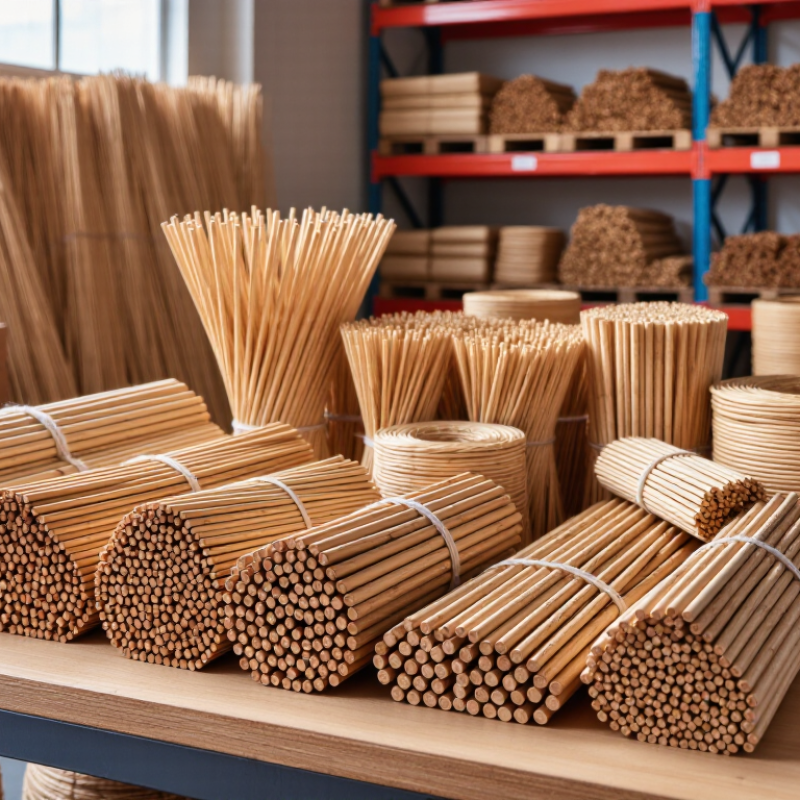
Rattan sticks are natural cane sections from climbing palms that grow in tropical forests. They are lightweight, flexible, and surprisingly strong. After harvesting, the cane is cleaned, dried, and graded by length, diameter, color, and surface quality. Some sticks keep their outer skin, while others are peeled or split for specific projects. The term is not perfectly consistent across suppliers. It may describe whole cane, thin rods, or processed strips.
Rattan sticks are widely used in furniture frames, baskets, lampshades, wall panels, and handmade decorations. They can also support small garden structures or form parts of craft models. In workshop use, straight sticks suit visible frames, while naturally curved pieces create softer shapes. Moisture matters. Poorly dried rattan may shrink, crack, or develop mold after installation. A reliable buyer checks packaging, storage conditions, and treatment details. No grade is perfect. Slight color variation is normal, and a small bend may be useful rather than defective.
Tips: Confirm the diameter and usable length before ordering. Ask for close-up photos of the surface. Store rattan sticks above the floor in a dry, ventilated room. Avoid sealing damp cane. That mistake is easy to make. Test a small batch before purchasing wholesale quantities.ેણ
Wholesale sourcing benchmark for selecting rattan-stick suppliers without relying on company or brand names.
| Data Dimension | Typical Wholesale Specification | What Rattan Sticks Are | Common Uses | Supplier Verification Point |
|---|---|---|---|---|
| Material Origin | Natural rattan cane harvested from climbing palms in the Calamoideae subfamily. | Rattan is a fibrous, flexible cane rather than a timber tree. The outer skin is generally smooth and durable when properly processed. | Furniture frames, basketry, handicrafts, garden structures, decorative poles, and weaving materials. | Request the botanical or commercial material description and confirm that the shipment is natural rattan rather than bamboo or synthetic cane. |
| Stick Form | Round solid cane, peeled cane, half-round cane, split cane, or polished rod. | Sticks may be supplied with the natural skin retained, partially peeled, or fully peeled according to the intended manufacturing process. | Round sticks suit frames and supports; split or half-round pieces suit weaving, edging, panels, and decorative work. | Ask for production samples showing surface finish, straightness, cross-section, and consistency between batches. |
| Common Diameter Range | Approximately 5–40 mm for many craft, furniture, and decorative applications; larger canes may also be available. | Diameter is normally measured at a specified point because natural cane can taper along its length. | 5–10 mm: crafts and light weaving; 10–25 mm: furniture and frames; 25–40 mm: heavier decorative or structural components. | Specify minimum, maximum, and allowable taper rather than ordering only by a nominal diameter. |
| Typical Length | Common commercial lengths are about 1.8–4.0 m, subject to species, harvest size, and processing capacity. | Long, continuous canes reduce the need for joints, while shorter cut sticks may be more economical for small products. | Long canes are used for furniture frames and railing; cut lengths are used for craft kits, baskets, and small components. | Confirm cut-length tolerance, straightness requirements, and whether mixed lengths are permitted in each carton or bundle. |
| Moisture Condition | Wholesale buyers commonly request kiln-dried or air-dried cane with a documented moisture range suitable for the destination climate. | Drying reduces excess moisture and helps limit mold, shrinkage, and dimensional movement during storage and use. | Important for indoor furniture, export packaging, weaving stock, and products stored in humid warehouses. | Require a moisture-measurement method, inspection timing, and packaging that allows ventilation while preventing re-wetting. |
| Surface Quality | Grades may be separated by straightness, color uniformity, skin condition, cracks, insect marks, knots, and polishing quality. | Natural rattan normally has variations in color and texture. Premium grades have fewer visible defects and more uniform dimensions. | Furniture and visible decorative products usually require cleaner surfaces; woven or painted products may accept more natural variation. | Use a written defect-acceptance standard with photos, sample approval, and an agreed inspection procedure. |
| Preservation Treatment | May be untreated, heat-treated, fumigated where legally permitted, or treated with borate-based preservatives depending on the market and end use. | Treatment is intended to reduce the risk of insects and fungal damage, but it does not replace proper drying and storage. | Recommended consideration for furniture, export shipments, humid regions, and long-term warehouse storage. | Request treatment details, safety documentation, applicable import requirements, and confirmation that the process matches the destination regulations. |
| Color and Finish | Natural tan, light brown, smoked, stained, painted, lacquered, or polished finishes may be available. | Color can vary with species, age, drying method, smoking, and surface treatment. | Natural finishes are common in furniture and baskets; stained or painted finishes are used for coordinated interior products. | Approve a physical color sample and define acceptable variation because photographs may not accurately represent natural cane color. |
| Packaging for Wholesale | Usually bundled by diameter and length, protected with straps, paper, woven covers, or cartons depending on the product form. | Proper bundling helps prevent bending, abrasion, contamination, and moisture absorption during transport. | Suitable packaging is especially important for long sticks, polished cane, and finished components with visible surfaces. | Confirm bundle quantity, gross and net weight, carton dimensions, moisture protection, and loading method before placing an order. |
| Quality Documents | Potential documents include packing list, commercial invoice, country-of-origin information, treatment statement, and inspection report. | Documentation supports customs clearance, traceability, and comparison of shipments from different sources. | Useful for importers, furniture manufacturers, retail wholesalers, and projects requiring repeatable specifications. | Check whether documents are consistent with the product description, shipment quantity, destination rules, and buyer’s compliance requirements. |
| Sustainability and Legality | Responsible sourcing should include legal harvest information, traceability, and compliance with applicable forestry and import regulations. | Rattan is a renewable non-timber forest product, but sustainability depends on harvesting practices, local governance, and supply-chain control. | Relevant to eco-conscious furniture, home décor, packaging, and projects with environmental procurement standards. | Request origin information and any applicable legal or sustainability documentation; do not rely on environmental claims alone. |
| Best-Fit Applications | Match the stick’s diameter, length, flexibility, surface quality, and treatment to the finished product. | Rattan sticks combine relatively low weight, flexibility, and workable natural fiber structure, but they are not automatically suitable for every load-bearing application. | Furniture, baskets, lampshades, trays, decorative screens, craft products, plant supports, and architectural detailing. | Request end-use testing when the cane will carry loads, remain outdoors, contact food, or be used in a regulated product. |
Wholesale purchasing note: The specifications above are common sourcing ranges and evaluation criteria, not universal standards. Final dimensions, treatment, tolerances, packaging, and compliance requirements should be confirmed in a written purchase specification and approved sample.