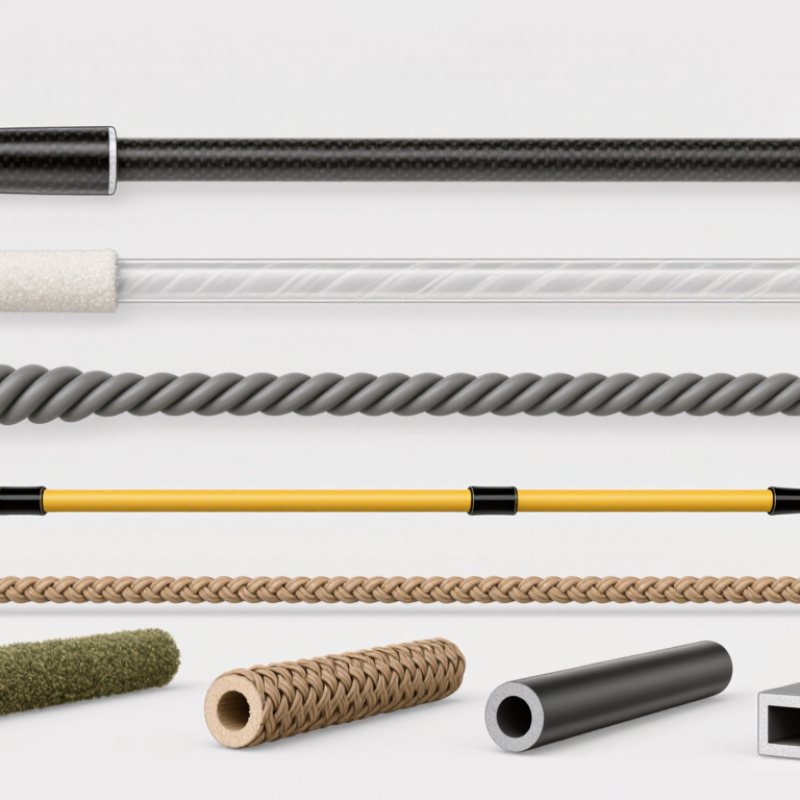
Global buyers are no longer choosing a Fiber Stick by appearance alone. Weight, tensile strength, surface finish, moisture resistance, and delivery stability now influence the purchase. The term may describe fiberglass rods, carbon-fiber sticks, pultruded profiles, flexible fish rods, or reinforced support shafts. These products can look similar in a catalog. Their performance can differ sharply.
MarketsandMarkets estimates that the global fiber-reinforced polymer composites market will continue expanding through the decade, supported by construction, transportation, energy, and telecommunications demand. Fortune Business Insights also reports steady growth in the fiberglass market, driven by lightweight reinforcement and corrosion resistance. The numbers are useful, but they do not replace product testing. That point is often missed.
Composites specialist Dr. Leonard Hollaway offers a practical warning: “FRP is not a universal replacement for steel.” Buyers should treat that principle seriously. A low-cost fiberglass stick may suit temporary marking, while a carbon-fiber version may better fit high-stiffness applications. Pultruded sticks offer consistent dimensions. Braided designs can improve flexibility. Coated options may perform better in wet or abrasive environments.
This guide compares ten common Fiber Stick types for international purchasing teams. It considers material structure, load behavior, tolerances, packaging, certification, and total landed cost. ISO 10406-1 and relevant ASTM methods can support technical checks, although standards vary by application and market. No single type wins everywhere. That is the uncomfortable part. Final selection still depends on drawings, test data, climate exposure, and honest supplier communication.
Fiber sticks are lightweight composite rods made from glass fiber, carbon fiber, or plant-based fiber. Glass fiber remains the common choice because it balances strength, flexibility, and cost. Carbon fiber is stiffer and lighter, but usually more expensive. Natural-fiber sticks feel less industrial and suit low-load applications.
Their structure matters. A typical stick contains continuous fibers inside a resin matrix. The fiber direction affects bending strength, while the outer coating improves handling and moisture resistance. Diameter, length, surface finish, and tolerance should match the working environment. Thin rods can guide cables or support small frames. Thicker rods may serve in agricultural supports, tent structures, fishing equipment, electrical insulation, and construction marking systems. Some designs need controlled flexibility. Others need firm load support.
Tips: Ask for tensile strength, bending radius, weight, and temperature range before ordering. Check whether the cut ends are sealed. Unsealed ends may absorb moisture or release sharp fibers during handling. Request samples when the stick will face repeated bending. Measurements can look correct on paper, yet feel unsuitable in real use. I have found that buyers sometimes focus on price and overlook storage conditions. Long rods need straight, dry storage. Poor stacking can create permanent bends. Also review local import rules and workplace safety requirements, especially when workers may cut or sand the material. A better specification is not always longer; it is clearer.
Fiber sticks usually guide light through acrylic or glass. Buyers should confirm the meaning before comparing quotations. The ten common types are acrylic end-glow, acrylic side-glow, glass end-glow, glass side-glow, solid-core, hollow-core, bare, jacketed, rigid straight, and flexible spiral designs. Acrylic sticks are lightweight and economical. Glass versions offer better temperature stability and lower optical loss. End-glow models create a focused point of light. Side-glow models produce a softer line along the surface.
Design affects installation. Bare sticks suit protected assemblies and short visible sections. Jacketed sticks resist handling damage. Rigid straight sticks fit signs, sensors, and display panels. Flexible spiral types work around curves, but bending can reduce brightness. Hollow-core designs may lower weight, although their real performance depends heavily on internal geometry. This is where product claims need careful checking.
The ITU Facts and Figures 2024 report estimated 5.5 billion people were online, increasing demand for compact optical and illuminated components. OECD Broadband Statistics 2024 also showed fiber represented about 43% of fixed broadband connections across member economies. These figures support long-term optical demand, but they do not prove every fiber stick is suitable for telecom use. Buyers should request attenuation, bend-radius, operating-temperature, and flame-rating data. IEC test references improve comparability. A practical sample test remains valuable. I have seen specifications look excellent on paper, yet uneven polishing caused visible dark spots.
Top 10 Types of Fiber Sticks for Global Buyers
Key Performance Differences Among Fiber Stick Categories
Fiber sticks differ mainly in transmission range, flexibility, protection, and installation speed. Single-mode glass fiber supports long-distance links with low signal loss, while multimode glass fiber suits shorter connections inside buildings. Plastic optical fiber is easier to handle, but its distance and bandwidth are usually lower.
Bend-insensitive fiber tolerates tighter curves around cabinets and wall channels. Loose-tube designs protect the core from moisture and temperature changes. Tight-buffered sticks offer simpler indoor termination and better handling during repairs. Armored versions resist crushing, rodents, and accidental impact, although they add weight and reduce flexibility.
Ribbon fiber groups many fibers together, improving mass splicing efficiency. Simplex sticks contain one fiber, making them useful for compact point-to-point connections. Duplex designs carry two channels and support paired transmit-and-receive systems. Multi-core structures increase capacity, but their termination process demands greater skill and cleaner tools.
In practical checks, measure insertion loss after cutting and connector installation. A stick that looks strong may still perform poorly after a rough bend. I have found that packaging quality matters more than expected. Dust caps, bend radius markings, and clear test records reduce installation errors. This comparison is not perfect, because climate, cable routing, and technician experience can change the result. A low-cost category may become expensive when rework begins.
The chart compares common optical-fiber cleaning stick categories using typical performance indices from 1 to 5. Higher scores indicate better relative performance for the selected attribute. Actual results vary with tip geometry, fiber material, connector type, solvent use, and manufacturing quality. Cotton-tipped sticks score lower for lint control, while polyester, microfiber, and foam designs generally provide better compatibility with precision optical connectors.
Selecting the right fiber sticks starts with the cleaning task, not the lowest quotation. Common options include:
Each design suits a different connector, adapter, or equipment surface. Check the tip material, shaft length, diameter, and particle-control performance before ordering.
A foam tip works well on broad, delicate surfaces. A narrow lint-free tip reaches recessed connectors. For sensitive optical equipment, antistatic construction can reduce dust attraction. If a cleaning liquid is required, request compatibility data for the selected solvent. Some shafts soften or shed particles after repeated exposure. That detail is easy to overlook.
Global buyers should request samples, inspection records, packaging specifications, and batch traceability. Confirm whether the sticks are individually packed or supplied in bulk. Individual packaging usually offers better contamination control during overseas handling. Ask for test data covering residue, fiber shedding, and dimensional tolerance. Recognized quality systems can support supplier evaluation, but certificates alone do not prove product performance. A practical trial is still necessary.
In one purchasing review, the cheapest sticks created more rework because their shafts bent inside narrow ports. The saving was not real. Also check customs descriptions, storage conditions, language requirements, and regional documentation before shipment. Even experienced buyers sometimes miss these details.
Top 10 Types of Fiber Sticks for Global Buyers?
International Standards, Packaging, and Sourcing Factors
Fiber sticks vary by application, so buyers should define performance before selecting a material. Common options include fiberglass rods, carbon fiber rods, glass fiber reinforced plastic sticks, aramid reinforcement rods, optical fiber cleaning sticks, and flexible composite sticks. Some are rigid and load-bearing. Others protect delicate cables or support industrial assemblies. Diameter, length, flexibility, surface finish, and temperature resistance should appear clearly on the specification sheet.
Standards depend on the end use. Optical products may require relevant IEC or ITU-T requirements, while composite rods may need ASTM, ISO, or equivalent national testing methods. Ask for tensile strength, bending results, dimensional tolerance, and moisture-resistance data. A quality certificate alone is not enough. Request batch numbers and sample test reports. In practice, small differences in diameter can affect assembly speed and field reliability.
Packaging deserves equal attention. Long sticks need rigid tubes, corner protection, and clear length markings. Moisture barriers help prevent swelling, corrosion, or surface damage during ocean transport. Use inner separators when products can scratch each other. Export cartons should show quantity, net weight, gross weight, and handling instructions. I have seen packaging look strong but fail at the corners. That detail is easy to miss. Buyers should also review production capacity, inspection frequency, lead time, tooling ownership, and traceability. A low price may hide unstable tolerances or excessive packaging waste. No checklist is perfect. Keep improving it after every shipment.
| No. | Fiber Stick Type | Typical Construction | Common Applications | Typical Size Range | Typical Performance Profile | Relevant International Standards | Packaging Recommendation | Key Sourcing Checks |
|---|---|---|---|---|---|---|---|---|
| 1 | Solid Pultruded E-Glass/Epoxy Rod | Continuous E-glass fibers aligned in an epoxy resin matrix; usually round and solid. | Electrical insulation, structural braces, antenna supports, composite assemblies, and industrial handles. | About 2–50 mm diameter; custom cut lengths commonly available. | High specific strength, low electrical conductivity, good corrosion resistance, and generally higher temperature capability than polyester systems. | ASTM D3917 for pultruded profile tolerances; ASTM D638 or ISO 527 for tensile properties; ASTM D790 or ISO 14125 for flexural properties. | Protective sleeves, moisture-resistant cartons, end caps, and rigid crates for long lengths. | Check fiber volume fraction, resin system, diameter tolerance, straightness, surface finish, and batch test reports. |
| 2 | Solid Pultruded E-Glass/Polyester Rod | Continuous glass reinforcement in an unsaturated polyester resin matrix. | General-purpose supports, agricultural structures, fencing, lightweight frames, and utility products. | About 3–40 mm diameter; standard and cut-to-length formats. | Cost-effective, corrosion-resistant, electrically nonconductive, and suitable for moderate mechanical loads. | ASTM D3917; ASTM D638 or ISO 527; ASTM D790; ASTM D2344 or ISO 14130 for interlaminar shear screening where applicable. | Bundle by diameter, use foam separators, seal against moisture, and label each bundle with length and lot number. | Confirm resin chemistry, UV stabilizer, color consistency, cut-end quality, and declared mechanical values. |
| 3 | Hollow Pultruded Fiberglass Tube | Glass fibers pultruded around a mandrel to form a round, square, or rectangular hollow profile. | Telescoping poles, robotics, machine guards, cable guides, and lightweight structural frames. | Outside diameter or width about 6–150 mm; wall thickness commonly 1–10 mm. | High stiffness-to-weight ratio; bending performance depends strongly on wall thickness, shape, and fiber orientation. | ASTM D3917 for dimensional tolerances; ASTM D790 or ISO 14125 for flexural testing; ISO 527 for tensile testing. | Use internal spacers, corner protection, moisture barriers, and rigid long-goods cartons or crates. | Verify inner diameter, concentricity, wall thickness, nesting compatibility, joint clearance, and allowable deflection. |
| 4 | Braided Fiberglass Composite Rod | Fiberglass yarns braided or wound around a core and consolidated with thermoset or thermoplastic resin. | Flexible supports, deployable structures, sporting equipment, springs, and impact-tolerant components. | About 3–30 mm diameter; flexible or semi-flexible designs are available. | Improved off-axis strength and damage tolerance compared with a purely unidirectional rod; stiffness varies with braid angle. | ASTM D3039 or ISO 527 for tensile characterization; ASTM D790 or ISO 14125 for flexural characterization; test method should match the braid architecture. | Avoid tight bending during shipment; use coil supports where permitted and rigid tubes for straight lengths. | Request braid angle, resin content, minimum bend radius, fatigue data, and proof of consistent consolidation. |
| 5 | Glass-Fiber-Reinforced Polymer Rebar | Continuous glass fibers in a resin matrix with a sand-coated, helically wrapped, or formed surface for concrete bond. | Concrete slabs, bridge decks, marine structures, parking facilities, and electrically sensitive infrastructure. | Nominal bar sizes commonly equivalent to approximately 10–32 mm; supplied in straight bars or coils depending on diameter. | Noncorrosive and nonmagnetic; lower elastic modulus than steel and typically linear-elastic until rupture. | ASTM D7957 for solid round GFRP bars; ACI 440.11 for structural concrete design; CSA S807 may apply in Canadian projects. | Use bundled, strapped pallets with separators; prevent abrasion, sunlight exposure, and unauthorized bending during transport. | Confirm bond surface, bar diameter, tensile strength, modulus, alkali resistance, bend limitations, and project-specific approvals. |
| 6 | Fiberglass Tent-Pole Section | Flexible fiberglass rods cut into short sections and connected with an elastic shock cord and ferrules. | Camping tents, shelters, temporary canopies, and recreational structures. | Individual sections commonly 300–700 mm long; outside diameter often 6–13 mm. | Designed for repeated flexing and low weight; performance depends on curvature, joint design, and fatigue resistance. | Relevant tent and shelter safety requirements may include EN ISO 5912; material testing can use ISO 527 or ASTM D638 where specified. | Pack complete pole sets in fabric sleeves or printed cartons; protect ferrules and include assembly instructions. | Check section matching, ferrule fit, shock-cord tension, splinter resistance, UV durability, and repeated-flex testing. |
| 7 | Fiberglass Flag and Banner Pole | Tapered or constant-diameter fiberglass rod, often supplied in interlocking sections or a continuous flexible length. | Flags, feather banners, event displays, beach markers, and outdoor signs. | Overall assembled lengths commonly 1.5–6 m; section diameters often 8–25 mm. | Lightweight, flexible, and corrosion-resistant; must be matched to wind load, banner area, and mounting method. | No single universal product standard; use ASTM D3917 for pultruded dimensional control and project-specific wind-load requirements. | Ship in rigid triangular cartons or tubes with end protection; separate sections to prevent rubbing and bending. | Confirm assembled height, taper, connector strength, wind rating, UV resistance, and compatibility with the base. |
| 8 | Fiberglass Fishing-Rod Blank | Hollow or solid glass-fiber composite tube with a controlled taper and a designed flex profile. | Fishing rods, youth equipment, marine poles, and flexible sporting goods. | Finished lengths commonly 1.5–3.6 m; blank diameters vary by taper and power rating. | High toughness and impact tolerance with slower flex action than many high-modulus carbon designs. | No single global fishing-blank standard; tensile and flexural screening may use ISO 527, ASTM D638, ASTM D790, or ISO 14125. | Use individual sleeves, tip protectors, rigid tubes, and moisture-resistant cartons for long blanks. | Specify length, sections, action, power, tip diameter, butt diameter, weight, straightness, and surface defects. |
| 9 | Glass-Fiber Cable-Fishing Rod | Flexible fiberglass rod or tape with a smooth polymer jacket, threaded connectors, and a pulling eye. | Routing cables through ducts, conduits, ceiling voids, and underground utility pathways. | Rod diameters commonly 4–16 mm; supplied in reels or drums with lengths from about 30–300 m. | Good pushability, controlled flexibility, electrical insulation, and abrasion resistance when properly jacketed. | IEC 60794-1-2 may be relevant when integrated with optical-cable systems; mechanical tests should be agreed in the purchase specification. | Use a rigid reel with a locking mechanism, sealed wrapping, protected connectors, and clear length markings. | Check minimum bend radius, tensile load, jacket hardness, reel braking, connector compatibility, and pull-force limits. |
| 10 | Aramid-Reinforced Composite Rod | Continuous aramid fibers in a resin matrix, sometimes combined with glass fibers or protected by an outer jacket. | Telecommunication cable strength members, lightweight tension elements, aerospace components, and protective supports. | Common diameters about 1–10 mm; larger custom profiles are possible. | Very low density, high tensile strength, low electrical conductivity, and good vibration resistance; compression and UV behavior require careful design. | IEC 60794 series may apply to optical-cable strength members; ISO 527 or ASTM D3039 can support material tensile characterization. | Use opaque moisture-barrier bags, controlled-reel packaging, bend-radius warnings, and sealed ends where applicable. | Confirm fiber grade, tensile strength, coating type, moisture uptake, UV exposure performance, elongation, and termination method. |

Buyer note: The dimensions and performance ranges are typical procurement references rather than universal specifications. Final requirements should be confirmed through an approved drawing, technical data sheet, inspection plan, and destination-market regulations.
Packaging and logistics note: Long fiber sticks are susceptible to bending, abrasion, and impact damage. Specify maximum bundle weight, pallet dimensions, moisture protection, labeling language, lot traceability, and applicable international shipping requirements before placing an order.